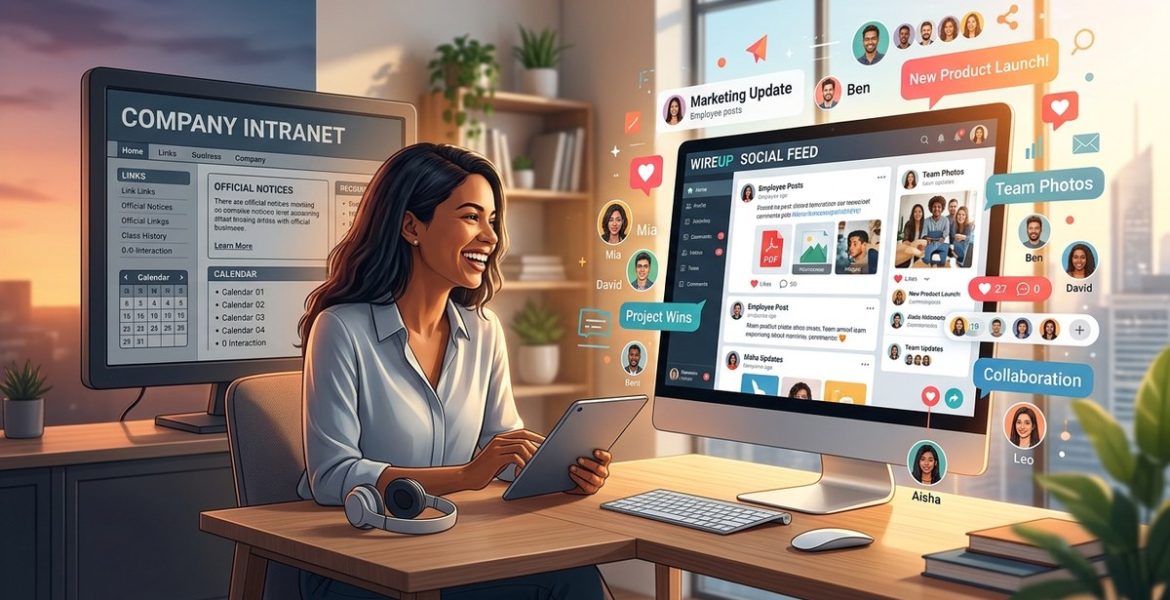
Why Your Remote Team’s Social Feed Should Replace Your Intranet in 2026
On 20 November 2026 by scarlettYou have poured time and budget into your intranet. You have organized the HR documents, created a shiny homepage, and sent out launch emails. Yet, six months later, your team only checks it when they need to find the password for the health insurance portal. You are not alone. Many VPs of People are facing the same frustration: low adoption, stale content, and a platform that feels more like a digital filing cabinet than a place where your team actually connects.
Traditional intranets fail because they are built for information storage, not human interaction. In 2026, the best intranet alternative for remote teams is a social feed. It fosters casual conversation, makes knowledge sharing feel natural, and gives your distributed team a central place to be human. This guide shows you exactly how to make the switch.
The Intranet Is a Relic of the Office Era
Think about what an intranet was designed to do. It was built for a time when most employees sat in the same building. You needed a place to post the cafeteria menu, the fire safety plan, and the CEO’s quarterly memo. It was a one-way broadcast system.
Your remote team in 2026 does not need a broadcast system. They need a conversation.
When you force a traditional intranet onto a distributed team, you get a ghost town. People do not log in because the content is static. There are no comments, no likes, and no sense of community. It feels like reading a company newsletter from 2007.
A social feed, on the other hand, feels familiar. It works like the platforms your team already uses in their personal lives. It invites participation. It is alive.
Why Your Team Already Knows How to Use a Social Feed
You do not need to train people on how to scroll, like, or comment. They already do it every day. The barrier to entry is zero.
This is the core reason a social feed is the superior intranet alternative for remote teams in 2026. You are not fighting against human nature. You are working with it.
Here are the specific pain points a social feed solves that an intranet cannot:
- Information discovery. On an intranet, you have to know where to look. On a social feed, relevant updates appear in your timeline.
- Cultural connection. An intranet cannot show you a photo of your colleague’s new puppy or a funny meme from the all-hands meeting. A social feed can.
- Asynchronous communication. A social feed allows people in different time zones to catch up without scheduling a meeting. They can scroll through the day’s highlights in five minutes.
The 3 Step Process to Replace Your Intranet
Making the switch does not have to be painful. Follow this numbered process to move from a static intranet to a dynamic social feed without losing the important stuff.
-
Audit your current intranet content. Go through every page and ask: “Does this need to be updated weekly?” or “Is this a one-time reference document?” Move one-time docs (like the employee handbook) to a shared drive or wiki. Keep only the living, changing content.
-
Choose your social feed platform. This does not have to be a brand new tool. Many collaboration platforms now offer social feed features. Look for one that allows threaded conversations, rich media (images, videos, GIFs), and searchable archives. Check out our guide on boost remote collaboration with top social network strategies for platform ideas.
-
Migrate your active channels. Move your “announcements” channel from the intranet to the social feed. Create dedicated spaces for “wins of the week,” “random watercooler,” and “ask me anything.” Archive the old intranet but keep it accessible for reference.
What to Keep and What to Ditch
Not everything on your intranet is useless. Some documents are essential. The key is knowing the difference.
| Keep in a Static Wiki | Move to the Social Feed | Ditch Entirely |
|---|---|---|
| Employee handbooks and policies | Company announcements and updates | Outdated org charts |
| IT security protocols | Project wins and shoutouts | Unused discussion forums |
| Benefits enrollment guides | Team photos and social posts | Pages with zero views in 90 days |
| Onboarding checklists | “Help wanted” or cross-team requests | Duplicate content from email chains |
The Hidden Trap: Turning Your Social Feed Into a New Intranet
This is the biggest mistake we see teams make. They move to a social feed but treat it like an intranet. They post only formal announcements. They ban memes. They moderate every comment before it goes live.
Do not do this.
A social feed needs to feel social. If every post sounds like it was written by the legal department, your team will stop reading. Let people be human. Let them post about their weekend. Let them share a funny video. This is how trust and connection are built in a remote environment.
“The best remote teams do not have perfect communication. They have frequent, low-stakes communication. A social feed creates the conditions for that to happen naturally.” — Samia A., Head of Remote Culture at a 300-person tech firm.
How to Measure Success After the Switch
You cannot just swap tools and hope for the best. You need to know if it is working. Here are the metrics that matter when using a social feed as your intranet alternative in 2026.
- Daily active users. What percentage of your team checks the feed at least once a day? Aim for over 70%.
- Post engagement rate. Are people liking, commenting, and reacting? A healthy feed has a reaction on at least one out of every three posts.
- Time to find information. Run a test. Ask five team members to find the latest PTO policy. If they can find it in under 30 seconds using the feed’s search, you are winning.
- Sentiment in 1:1s. Are your managers hearing less “I feel out of the loop” from their reports? That is a qualitative win.
If you want to go deeper on virtual interactions, our article on maximize virtual meetings and file sharing for seamless teamwork offers complementary strategies.
Common Mistakes That Kill Adoption
Even with the best tool, adoption can fail. Watch out for these pitfalls.
- Forcing everyone to use it. Mandates create resentment. Instead, model the behavior. Have the CEO and leadership team post first.
- Not having a moderation policy. Without guidelines, the feed can become noisy or, worse, toxic. Set clear rules about respect and relevance. We have a full guide on why your remote team’s social network needs a moderation policy.
- Ignoring time zones. Do not expect everyone to reply instantly. A social feed is async by nature. Encourage people to catch up at the start of their day.
- Treating it as a dumping ground. If you post every single company update, people will tune out. Curate the feed. Only post what is genuinely interesting or important.
Making the Social Feed Your Team’s Central Hub
In 2026, the line between work and life is blurrier than ever. Your team does not want a separate “work” tool and a separate “social” tool. They want one place where they can get work updates, see what their colleagues are doing, and feel like they belong.
That place is not a static intranet. It is a living, breathing social feed.
When you make this switch, you are doing more than changing a tool. You are changing how your team communicates. You are saying, “I trust you to be professional and human at the same time.” That trust is the foundation of a strong remote culture.
For more on building that culture, read our piece on how to build a thriving remote team culture with social networking.
Your Social Feed Is the Future of Internal Comms
The intranet had its moment. That moment is over. For a remote team in 2026, the best internal communication tool is one that feels less like a tool and more like a place. A social feed provides that space. It is where announcements become conversations. Where documents get context. Where your team becomes a community.
Start small. Pick one channel to move over. See how your team responds. Chances are, they will wonder why you did not do it sooner.
Leave a Reply