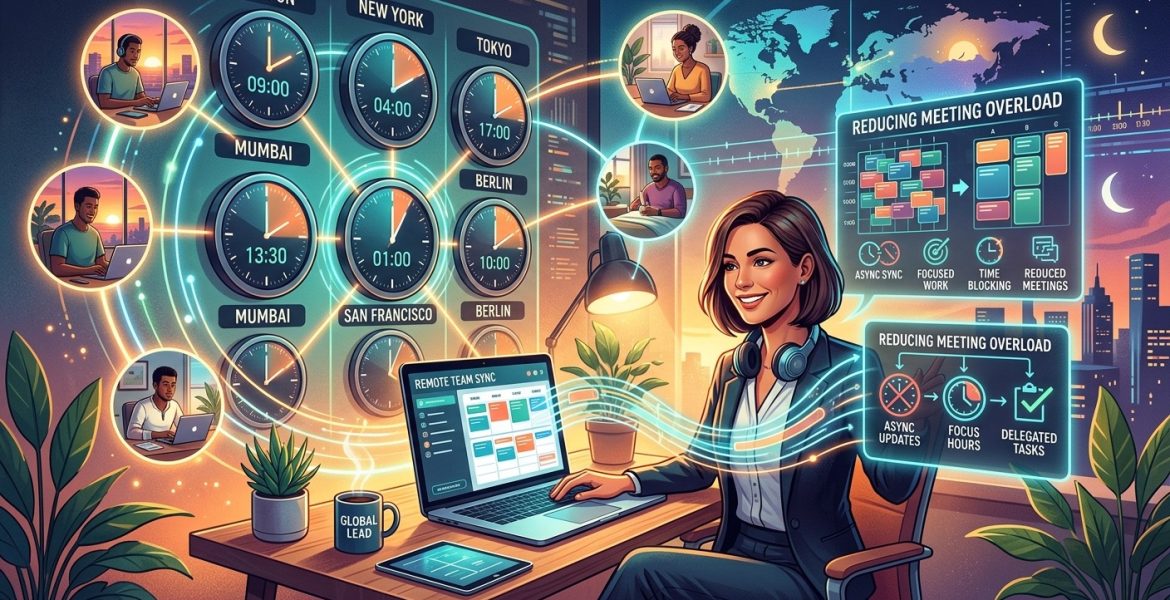
How Remote Managers Can Reduce Meeting Overload Across Time Zones
On 16 September 2026 by scarlettYour team spans three time zones and nobody has said it out loud yet, but the calendar is already eating them alive. Back-to-back video calls, status updates that could have been a two-line message, and meeting invites landing at 9 p.m. for someone in Singapore who has been up since 6 a.m. The calendar was supposed to create structure. Instead, it has become the single biggest obstacle to deep, focused work in your distributed organization, and most managers do not realize how much it is costing them until the damage is visible in output and morale.
The Meeting Overload Fix
Unstructured meeting calendars cost distributed teams far more than time. They drain decision-making energy, fracture focus across time zones, and quietly breed resentment. The path forward is a structured audit of your current meeting cadence, a deliberate shift toward async-first communication, and purpose-built tooling that makes the meetings you keep genuinely worth attending. Done right, this process regularly reclaims multiple hours per person each week and creates a measurably healthier team culture.
When Meeting Overload Starts Costing You Real Productivity
The damage rarely shows up first in performance reviews or sprint velocity charts. It shows up in smaller, quieter ways. People stop preparing for calls because there are too many to prepare for. Decisions get deferred because the right people are never available at the same time. The work that actually moves projects forward gets compressed into whatever sliver of time is left between calls, and that sliver shrinks every week.
According to remote meeting frequency data from Microsoft’s research division, the average user attended 2.5 times more meetings after the shift to distributed work accelerated. That is a dramatic increase, and it happened without most organizations redesigning their communication structures to absorb it. Teams inherited more calls without shedding the ones that no longer served them.
Decision fatigue compounds every other problem. A team cycling through back-to-back calls all morning arrives at the meeting that actually matters, the one where strategy gets set or a client commitment gets made, running on empty. Cognitive reserves are finite. Poorly structured calendars burn through them fast. The cost of that depletion rarely appears in any dashboard, but it shows up reliably in outcomes, and experienced managers start to recognize the pattern.
Running a Proper Audit of Your Team’s Meeting Habits
Before changing anything, you need a clear picture of what you are actually dealing with. Most managers have a general sense that there are too many meetings. But “too many” is not a number you can act on. An audit gives you one, and it gives your team the experience of being seen before the restructure begins, which matters more than most leaders expect.
Here is a structured five-step process to run the audit over two weeks:
- Pull calendar data for every team member and calculate total meeting hours, the number of distinct meetings, and how many overlap with other commitments or fall outside standard working hours for each person’s time zone.
- Categorize each meeting by its primary function: decision-making, status update, brainstorming, relationship-building, or training and onboarding.
- Flag every recurring meeting and ask honestly whether it still serves its original purpose. Many recurrings outlive the project that created them by months, sometimes longer.
- Identify the heaviest meeting days for each person, noting which time zones are absorbing the most scheduling burden and whether that burden is rotating fairly or fixed on the same region every week.
- Survey your team with two direct questions: which meetings do you find genuinely valuable, and which ones could have been handled a different way? The answers will surface things the calendar data alone cannot tell you.
The survey step matters more than most managers expect. Your team holds information you do not have access to from a top-down view. They know which calls feel like performance and which ones drive actual decisions. That knowledge should directly shape what stays and what gets cut or restructured.
Building an Async-First Foundation That Actually Works
Async-first does not mean “never meet.” It means defaulting to non-real-time communication for everything that does not genuinely require live discussion. Naming that distinction clearly, and writing it down as a team norm, is the step most organizations skip. It is also the reason so many async initiatives quietly fail within a quarter.
Status updates are the largest category of meeting time that can be reclaimed. A five-minute sync about where a project stands is something a well-maintained project tracker or a short recorded video can handle with equal accuracy and far more flexibility. The record is permanent, searchable, and accessible to your team member in Auckland who should not be on a call at 9 p.m. to learn that the API build is 70 percent complete.
Brainstorming deserves a more honest look. Some teams genuinely generate stronger ideas in real-time conversation. Others produce better thinking when they have time to write, reflect, and respond before the group converges. Testing both formats over a quarter gives you actual data rather than assumptions, and the results often surprise managers who assumed live debate was the only path to creative output.
The meetings that earn their place on the calendar are the ones where interpersonal dynamics genuinely matter. Difficult feedback conversations, high-stakes decisions that require live debate, and team rituals that build relationships across geography, those deserve scheduled time. Everything else is a candidate for a different format, and treating it that way is not a downgrade. It is a sign of respect for everyone’s working hours.
Choosing Tools That Help Your Team Meet with Intention
Tooling is not where the restructuring should start, but it is where the gains get locked in over time. Once you have audited your current state and defined what needs real-time coordination versus what does not, you are positioned to choose tools that match the structure rather than fight against it.
For the meetings that stay on the calendar, coordination quality matters a great deal. Teams that use purpose-built platforms for distributed team meetings tend to run shorter, more structured sessions because the tooling enforces agenda-setting before a call starts, captures decisions as they are made, and generates follow-up tasks without requiring a context switch to a separate app. A 45-minute call with that kind of scaffolding often resolves in 25 minutes with clearer outcomes for everyone involved.
For async work, the combination of a shared documentation tool, a project tracker, and a short-form video messaging platform covers most communication needs for most teams. The critical element is standardization. When team members have to guess which tool a given type of communication lives in, the confusion creates its own category of overhead. A clear, written communication charter, even a simple one-page document pinned where everyone can find it, removes that guesswork entirely.
Sync Versus Async: Matching Format to Communication Type
| Communication Type | Recommended Format | Key Reason |
|---|---|---|
| Project status updates | Async (written or recorded) | Searchable, time-zone flexible, no scheduling friction |
| High-stakes decisions | Sync | Live debate surfaces risks; real-time alignment prevents costly delays |
| Creative brainstorming | Test both formats | Output quality varies by team; measure before committing to one mode |
| Performance feedback | Sync | Interpersonal nuance requires real-time presence and responsiveness |
| Training and onboarding | Async (recorded) | Replayable content is accessible across all time zones at any pace |
| Team rituals and check-ins | Sync (brief and regular) | Relationship-building across distance needs real-time moments to take root |
Protecting Every Time Zone Without Losing Team Alignment
One of the most common mistakes distributed managers make is treating time zone fairness as a one-time fix. They find a meeting window that accommodates most people, set it as a recurring slot, and move on. But distributed teams change. People relocate. Coverage areas expand. What worked six months ago starts burdening a different region without anyone noticing until the resentment is already baked in.
A more durable approach is to build a “meeting window” policy: a defined band of hours during which real-time meetings can be scheduled, representing the genuine overlap between your team members’ core working hours. Outside that window, async is the default, not the exception. This is not a suggestion. It is a structural rule that protects focused time for everyone outside the overlap zone, and it needs leadership to enforce it consistently before it becomes part of the culture.
For teams where meaningful overlap simply does not exist, rotating meeting times is the honest path forward. No single time zone should permanently absorb the cost of inconvenient scheduling. If your Auckland team takes the early call this quarter, rotate it next quarter. That rotation signals something more important than fairness. It signals that leadership is paying attention, and that kind of attentiveness has a measurable effect on retention in distributed teams where feeling invisible is a genuine risk.
The Numbers That Prove Your Overhaul Is Working
Reclaimed hours per week is the most direct measure to track after a restructure. If your average team member was in 12 hours of meetings before and is now in seven, that is five hours of recovered capacity per person. Across a 10-person team, that is 50 hours per week redirected toward work that actually moves projects forward. Operations leads presenting this to leadership will find it translates quickly into ROI language that resonates across departments.
Meeting frequency is a useful companion metric. Track the number of distinct meetings each person attends per month and watch the trend over time. A downward trajectory alongside stable or improving project output is a strong signal that the system is working as designed. If frequency drops but satisfaction scores fall alongside it, that combination signals the team feels disconnected rather than liberated, and the restructure needs a targeted adjustment rather than a full reversal.
Team satisfaction scores, gathered through a lightweight monthly pulse survey, provide the human layer that hours and frequency data cannot. Reclaimed time means nothing if the team still feels overwhelmed, or worse, invisible to each other. Satisfaction data tells you whether the new structure actually feels better to the people living inside it every day, which is ultimately the only version of success that sustains itself.
Decision speed is the final metric worth tracking consistently. Measure how long it takes from identifying a decision point to reaching an actual decision and acting on it. Bloated meeting cultures stretch this timeline significantly, often in ways that are hard to trace to the calendar until you measure both together. A leaner, more intentional communication structure compresses it, and that compression shows up in both project timelines and team morale. When decisions move faster, teams feel more capable, and that confidence has a compounding effect that no dashboard fully captures but every manager eventually learns to recognize.
Leave a Reply