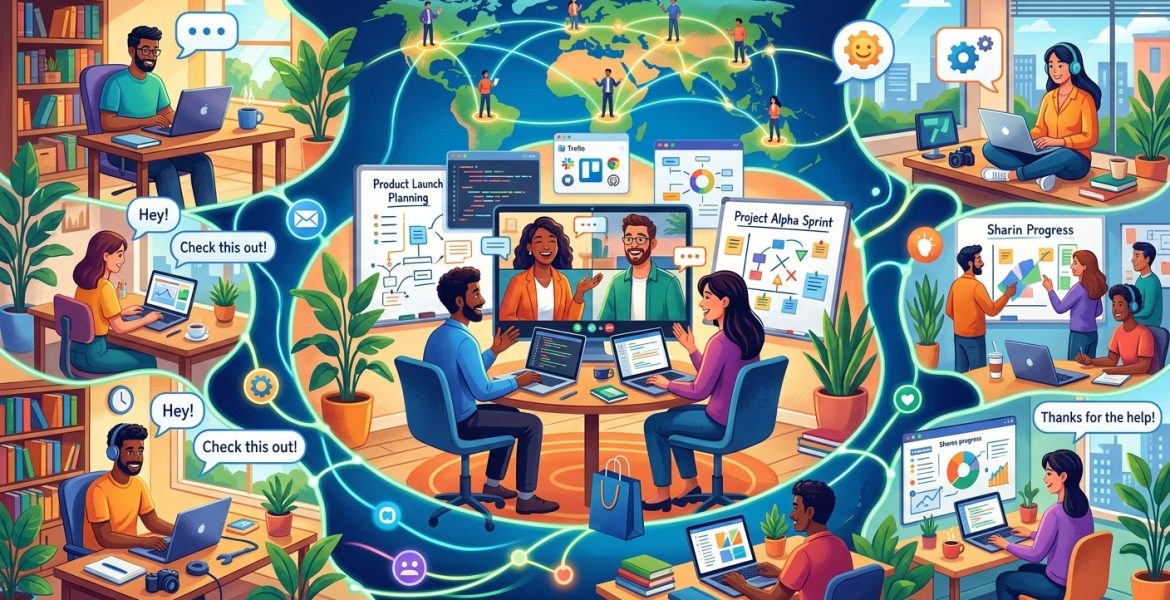
Reducing Social Isolation in Distributed Teams Without Forced Fun
On 4 October 2026 by scarlettThe resignation letter is the last thing that moves. Before that, you get weeks of one-word Slack replies, async threads nobody responds to, and team channels that go quiet by Thursday afternoon. Remote social isolation does not announce itself with a dramatic event. It seeps in gradually, and by the time a manager notices the drop in Slack engagement, the damage has been building for months. This is the slow-burn problem that no amount of scheduled icebreakers has ever truly fixed.
Remote Reality Check
- Social isolation in distributed teams surfaces as quiet disengagement long before it shows up as a resignation.
- Optional, low-stakes connection activities consistently outperform mandatory team events for building genuine relationships.
- Tracking onboarding satisfaction scores and 90-day retention rates gives operations leads a concrete business case for investing in informal culture.
The Slow-Burn Productivity Drain Nobody Talks About
Distributed teams lose connection in small increments. A developer stops asking questions in public channels because it feels like shouting into a void. A customer success manager starts skipping the optional Friday standup. A new hire spends their first month learning the tools but never learning any names. None of this looks like a crisis from the outside.
But research on social connection at work consistently links belonging to measurable performance outcomes. When employees feel isolated, cognitive load from unresolved social uncertainty competes with actual work. Decision-making slows. Risk aversion increases. Collaboration drops to the minimum required to close tickets, not the kind that sparks original thinking.
The signal to watch for is not anger or complaints. It is flatness. Shorter messages. Fewer reactions in social channels. Threads that get resolved without anyone saying more than strictly necessary. This is what the productivity drain looks like up close, and it begins appearing long before anyone writes a Glassdoor review.
Why Shallow Async Exchanges Become the Default
Async communication is the backbone of distributed work. It handles status updates and documentation well. It handles the kind of ambient socialization that used to happen by accident in a shared office poorly. Nobody is going to send a Slack message that says “just wanted to chat about nothing in particular.”
The result is a version of communication that is relentlessly transactional. Every message has a purpose. Every thread has a resolution. There is no space for the tangential remark that builds a real impression of who someone is. Over time, teammates become functions rather than people. That is not a values problem. It is a structural one, and it needs a structural fix.
That fix does not have to be a mandatory fun hour.
What Forced Fun Gets Wrong
The instinct to schedule connection is understandable. Managers see the gap, they book a time, they send an invite. But mandatory social events come with exactly the dynamics that make introverts, time-zone-straddled employees, and burned-out contributors least likely to show up authentically.
There is a practical problem too. Remote employees are often juggling competing obligations. A scheduled virtual games night at 5 PM EST is midnight in Eastern Europe and 6 AM in parts of Asia Pacific. What feels like inclusivity in planning produces exclusion in practice.
The deeper issue is consent. When participation feels compulsory, the social event becomes another task on the list. People show up with the part of their brain that handles professional obligations, not the part that actually connects with other humans. You get polite compliance, not warmth. That is not a failure of the people attending. It is a design failure.
Scheduled Events vs. Informal Activities: How They Compare
| Factor | Scheduled Team Events | Optional Informal Activities |
|---|---|---|
| Participation | High attendance, low authenticity | Lower count, higher genuine engagement |
| Perceived pressure | Often feels mandatory despite framing | Low, especially with async formats |
| Relationship depth | Surface level, transactional | Deeper, built on shared interests |
| Time-zone fairness | Often disadvantages one region | Async options work across all zones |
| Manager effort | High setup and facilitation cost | Low once channels are established |
| Lasting impact | Fades between sessions | Builds incrementally over time |
Low-Stakes Connection That People Actually Choose
The alternative to forced fun is not no fun. It is creating conditions where connection can happen naturally, without anyone being conscripted into it. Small, optional, and interest-based is the formula that works.
Multiplayer games are worth mentioning here because they do something most async tools cannot. They create shared narrative. Two people who survive the same chaotic round of a game together have a story. They have inside references. That is the raw material of team culture, and it does not require anyone to sit in a circle and say something vulnerable.
Before scheduling a full session, some managers find it useful to gauge interest informally. Posting a casual question like have you ever multiplayer gamed with colleagues gives you a real read on enthusiasm before you commit anyone’s time. It is a pulse-check, not a mandate, and the answers tell you more than a mandatory RSVP ever would.
Activity formats that tend to land well with distributed teams:
- Drop-in voice channels with no agenda, audio-only to reduce camera fatigue
- Async trivia or puzzle challenges posted in Slack or Teams with a thread for answers
- Interest-based channels that are fully opt-in, covering topics like cooking, hiking, or book recommendations
- Virtual co-working sessions where people work independently but remain on a call for ambient presence
- Brief monthly show-and-tell where anyone who wants can share a personal project, hobby, or skill
Building Connection Into the Workflow Without Adding Overhead
One reason social connection programs stall is that they get treated as a separate initiative. They live outside the core workflow, get deprioritized during busy quarters, and fade without anyone consciously deciding to kill them. The fix is to attach informal connection to moments that already exist in the team’s routine.
Here is a sequence that operations leads have used to get this started without a large launch:
- Audit the existing calendar. Find meetings where social connection could naturally happen in the first few minutes without extending the agenda. Weekly syncs, sprint retros, and all-hands all have margin for this.
- Create two opt-in channels around the team’s existing interests. Survey the team with three options and let them vote. This signals that the topics are theirs, not the company’s.
- Frame it as a 90-day experiment. Tell the team you are trying this for a quarter and will check in on whether it feels useful. A time-boxed experiment removes the pressure of a permanent new obligation.
- Designate a rotating social host. One team member per month owns the informal connection layer. They post the async prompt, drop the co-working invite, or nudge the games channel. Rotating this distributes the labor and builds shared ownership.
- Tie the review to data. At the 90-day mark, review onboarding satisfaction survey results and check whether new hires report stronger team connection than the prior cohort. That becomes your metric, not gut feeling.
None of this requires a budget line or a vendor contract. It requires consistent attention and a manager who models the behavior by showing up to the informal channels themselves.
Onboarding Satisfaction as the Earliest Warning System
New hires are the most honest signal in this process. They arrive without existing relationships, without in-jokes, without any social capital. How quickly they feel connected is a direct measure of whether the informal culture is actually functioning.
A Surgeon General advisory on loneliness frames this not just as a workplace issue but as a public health concern, linking social isolation to reduced cognitive performance and elevated turnover risk. Remote workers sit squarely at the intersection of both. That gives operations leads real grounds for treating informal connection as infrastructure, not entertainment.
Tracking onboarding satisfaction at the 30, 60, and 90-day marks gives you time-series data on whether connection is building or stalling. Two metrics that operations leads find most useful in this window:
- Onboarding satisfaction score at 90 days: Ask specifically about team connection, not just tool proficiency or role clarity. A question like “I feel like I know at least three colleagues as people, not just job titles” gives you a direct measure of social integration.
- Voluntary turnover between months three and nine: This window captures the period after the initial honeymoon phase and before someone has built enough tenure to feel loyal. High turnover here often points to isolation, not compensation.
These two data points, tracked together across hiring cohorts, create a business case that is harder to dismiss than a general concern about team morale. When you can show that cohorts with stronger informal culture scores stay longer, that conversation changes at the budget level.
When the Culture Is Actually Holding
You do not need a perfectly engineered social program. You need a team where people occasionally say something that has nothing to do with a ticket, where new hires feel seen before their first month is up, and where managers notice the quiet ones rather than only rewarding the loudest participants.
The teams that get this right are not the ones running the most events. They are the ones where informal connection is treated as infrastructure. They build it into the edges of existing routines, keep it optional, measure what actually matters to the business, and adjust when the numbers move.
Remote isolation is real. The answer is not a costume contest or a trivia night that 40% of the team cannot attend. It is a deliberate, lightweight architecture of small moments that compound over time into something that feels, genuinely, like a team.
Leave a Reply